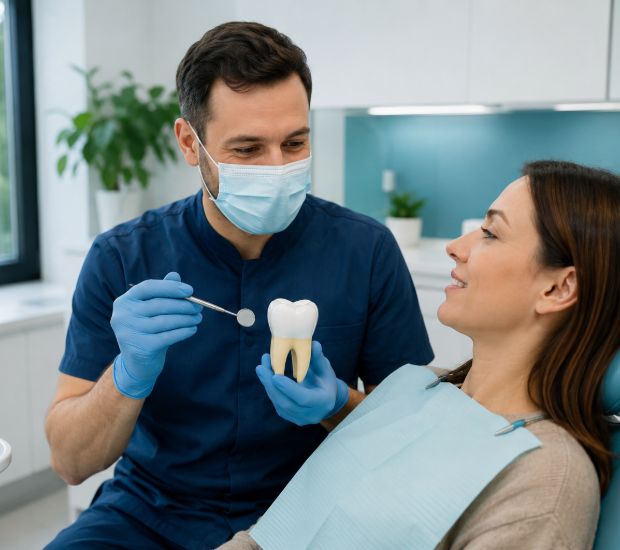
Dental Crown vs. Filling: How Do Dentists Decide? in Whittier, CA
When it comes to a dental crown vs a filling, dentists decide based on how much healthy tooth is left. A filling repairs a tooth that is still mostly intact, while a crown caps and protects a tooth that is too weak, cracked, or broken for a filling to hold. As a rule, the more natural tooth structure that remains, the more likely a filling is the right choice.
At Bailey Family Dental in Whittier, we base this decision on what the tooth actually needs, not on doing more than necessary. When a tooth-colored filling will restore and protect the tooth, that is what we recommend; when it will not, a dental crown is the safer long-term choice.
Clinical insight: the single biggest factor is how much solid tooth wall surrounds the damage. Once too little healthy structure remains, a filling flexes under chewing and can split the tooth — and that is the point where a crown becomes worth it.
If you have been told you need a crown and want to understand why — or simply want a second opinion — call Bailey Family Dental in Whittier at (562) 698-8739 to schedule an evaluation.
What Is the Difference Between a Dental Crown and a Filling?
A filling and a crown solve the same basic problem — a damaged tooth — in two very different ways. A filling replaces the part of the tooth that decay or a small fracture removed, bonding a tooth-colored composite into the space. Most of the natural tooth stays and keeps doing the work of chewing.
A crown does not fill a hole; it covers the whole tooth like a cap. The dentist reshapes what remains and bonds a custom dental crown over the top, so the crown — not the weakened tooth — absorbs the force of biting. That difference is exactly why the amount of healthy tooth left is what tips the decision.
When Is a Filling Enough?
For most small to moderate cavities, a filling is all a tooth needs. If decay is caught early and the walls of the tooth are still strong, a filling restores it conservatively and can last many years. Catching problems at this stage is one of the best reasons to keep up with a routine dental checkup.
Fillings also work well for chips, shallow cracks, and worn edges. As long as enough solid tooth surrounds the repair to support it, adding a crown would mean removing healthy structure for no real benefit. Seeing how decay advances through the stages of tooth decay helps explain why timing matters so much.
“The more healthy tooth that remains, the more a filling makes sense — a crown is for when there is not enough left to protect.”
When Does a Tooth Need a Crown Instead?
A crown becomes the better choice when a filling would not have enough tooth to hold onto, or when the tooth is too weak to survive normal chewing. That usually follows a large cavity, a broken cusp, a deep crack, or a root canal. In those cases a filling tends to loosen or the tooth cracks further, so full coverage protects the tooth.
Situations that commonly call for a crown include a cracked tooth, a very large old filling that keeps failing, or decay that has reached under an existing restoration — a cavity under a filling or crown. For an especially deep cavity, the options can widen to a filling, a crown, or a root canal, which we compare on our large cavity treatment page.
How Do Dentists Decide Between a Crown and a Filling?
The decision comes down to a few practical questions: How much healthy tooth is left? Where is the damage — a chewing surface that takes heavy force, or a low-stress spot? Is there a crack, and how deep does it run? Has the tooth had a root canal? The answers tell us whether a filling can be supported or whether the tooth needs full coverage.
X-rays and a direct exam fill in what the eye cannot see. If a filling can restore the tooth and is likely to last, that is the conservative call. If the tooth would stay fragile, a crown is the honest recommendation — not an upsell. We walk patients through that reasoning, which is also the focus of our guide on whether you really need a dental crown.
How Much Healthy Tooth Has to Be Left?
There is no single millimeter rule, but the principle is simple: a filling needs enough surrounding tooth wall to grip and to share the load of chewing. When a cavity or old filling takes up roughly half or more of the tooth, or the walls left behind are thin, a new filling is likely to flex, leak, or fracture the tooth over time.
At that point a crown does the job a weakened wall cannot — it wraps the tooth and holds it together. This is why two cavities that look alike on the surface can lead to different recommendations: what matters is the solid structure underneath, not just the size of the visible hole.
“We recommend a crown when a tooth cannot safely support a filling — not simply because it has been treated before.”
Do Cracks and Biting Force Change the Decision?
Yes — often decisively. A crack changes everything, because a filling cannot stop a crack from spreading while a crown holds the tooth together and keeps the crack from opening under pressure. Molars, which absorb the most biting force, are more likely to need a crown than a low-stress front tooth with the same damage.
Signs a tooth may be cracked include sharp pain when you bite and release, or pain that comes and goes. If you notice tooth pain when biting down, have the tooth checked before the crack deepens — an early crown can sometimes save a tooth that would otherwise need more.
What About a Tooth After a Root Canal?
A tooth that has had root canal treatment often has less remaining tooth structure and may be more prone to fracture, especially because root canal treatment usually follows extensive decay. Back teeth in particular are prone to fracture afterward, so a crown is generally recommended to protect the tooth and let it chew normally again.
Front teeth after a root canal sometimes do fine with a filling, since they take less force. As with every case, the decision depends on how much tooth is left and where it sits in the mouth — not on a blanket rule.
How Do Cost and Longevity Compare?
A filling costs less than a crown and takes a single visit, which makes it the practical choice whenever it will genuinely last. A crown costs more and usually takes two visits, but on a tooth that truly needs it, a crown often outlasts a filling that was asked to do too much and failed early.
The most expensive path is usually the wrong restoration. A filling placed on a tooth that needed a crown can fail and crack the tooth, turning a moderate repair into a root canal or an extraction. Choosing the right level of care the first time tends to be the most economical over the life of the tooth.
“The costliest choice is the wrong one — a filling that fails on a tooth that needed a crown can cost you the tooth.”
Is There a Middle Option Between a Filling and a Crown?
Sometimes, yes. When a tooth is too damaged for a routine filling but still has strong walls, an inlay or onlay can be the answer. These are custom-made restorations, stronger than a filling, that cover part of the tooth without reshaping it as much as a full crown does.
An onlay is sometimes called a partial crown for this reason. Whether it is an option depends on how much healthy tooth remains and where the damage sits — another reason the decision is made tooth by tooth rather than from a chart.
Why Choose Bailey Family Dental in Whittier?
At Bailey Family Dental in Whittier, our approach is to preserve as much healthy tooth as possible and recommend the right level of care without pressure. When a filling will do, we place a filling; when a tooth needs a crown to survive, we explain exactly why and what the alternatives are.
You will always understand the reasoning behind a crown-versus-filling recommendation before anything is done. If you would like a clear second opinion on a treatment plan, we are glad to provide one.
See our Google reviews: Read what patients are saying about Bailey Family Dental
Questions Answered on This Page
Dental Crown vs. Filling FAQs
Q. Is a crown always better than a filling?
A. No. A filling is the better choice whenever enough healthy tooth remains to support it. A crown is better only when the tooth is too weak or damaged for a filling to hold safely.
Q. Can I choose a filling to save money if my dentist recommends a crown?
A. You can discuss it, but a filling placed on a tooth that needs a crown often fails and can crack the tooth, leading to costlier treatment. Ask what specifically makes a crown necessary for your tooth.
Q. Does getting a crown always mean I need a root canal?
A. No. A crown protects a tooth from the outside, while a root canal treats infection inside it. Many crowns are placed on teeth that never needed a root canal.
Q. How do I know if my tooth needs a crown or a filling?
A. It depends on how much solid tooth remains, whether there is a crack, and how much biting force the tooth takes. An exam with X-rays usually gives a clear answer.
Q. Is an onlay a good compromise between a filling and a crown?
A. It can be. When a tooth is too damaged for a filling but still has strong walls, an inlay or onlay restores it while preserving more natural tooth than a full crown.
Q. Will a filling or a crown last longer?
A. On a tooth suited to it, either can last many years. The bigger factor is matching the restoration to the tooth, because the wrong choice tends to fail early regardless of type.
Reviewed by Brian Choi, DMD
General Dentist at Bailey Family Dental in Whittier, CA
Reviewed: October 2026
Not sure whether you need a crown or a filling?
We will examine the tooth, take any X-rays needed, and explain honestly whether a filling, an onlay, or a crown is the right level of care — and why.
Call Bailey Family Dental in Whittier at 562-698-8739 to schedule an evaluation.