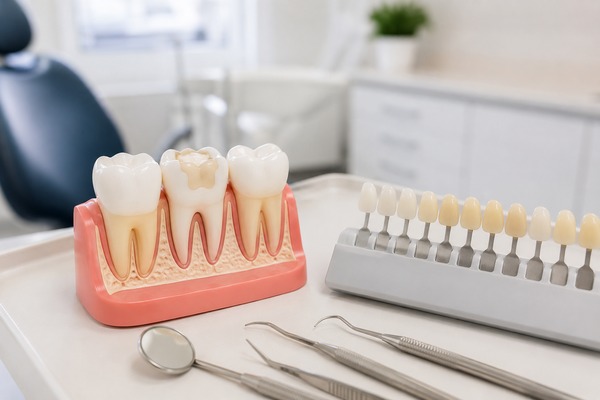
Composite Fillings Whittier, CA
Quick answer: Composite fillings are tooth-colored restorations that can repair selected small to moderate cavities. They work best when enough healthy tooth remains to support a filling.
At Bailey Family Dental in Whittier, we check the cavity's size and depth, the tooth's strength, your symptoms, and your bite. Then we explain whether a composite filling or another restoration offers the more predictable option.
Composite fillings at a glance
- Common use: A small to moderate cavity with enough healthy tooth structure.
- Appearance: The material can be matched to the surrounding tooth.
- Visit: We remove decay, bond and shape the material, and check the bite.
From our clinical approach: We do not choose a filling just because an X-ray shows decay. We also consider how much tooth is left, whether the tooth is cracked or painful, and whether the repair is likely to hold up under that patient's bite.
If you were told you may need a filling, call Bailey Family Dental at (562) 698-8739 to schedule an evaluation.
What Are Composite Fillings?
A composite filling is a tooth-colored resin restoration. A dentist places it directly into a prepared tooth after removing decay or damaged structure. The material is bonded, shaped, hardened, and polished during the visit.
Composite can blend with natural enamel, so dentists may use it on front or back teeth. However, the cavity's size, the bite, and the amount of healthy tooth still matter. If you are comparing materials, read Tooth-Colored Fillings vs. Silver Fillings.
What matters beyond color: In our office, we also look at the repair's size, the pressure on that tooth, and whether we can keep the area clean and dry during bonding. Those details can matter as much as choosing a shade.
This page focuses on the composite filling service. For a broader explanation of how dentists diagnose and treat decay, visit our Cavity Treatment page.
“`“A composite filling is best for a tooth that still has enough healthy structure to support the restoration.”
When a Composite Filling May Be Used
A composite filling may be an option when damage is small to moderate and the tooth does not need full coverage. The goal is to remove decay, preserve healthy structure, and seal the repair with a tooth-colored material.
A composite filling may be considered for:
- Small to moderate cavities: A filling may work when decay can be removed and enough tooth remains. If you are unsure whether treatment is necessary, read Does a Cavity Always Need a Filling?
- A selected old or failing filling: Some teeth can receive a new composite restoration. Learn the warning signs on our Can an Old Filling Leak or Fail? page.
- A minor chip or worn area: Composite may restore shape or cover exposed structure in selected cases.
- A visible part of the smile: Tooth-colored material may be useful when appearance matters.
- Selected sensitive areas: Composite may cover an exposed or worn surface after the cause is identified.
A common point of confusion: A dark spot, sensitive tooth, or old filling does not automatically mean that a new filling is the answer. We first identify the cause and then match the repair to the amount of sound tooth that remains.
If cold is the main trigger, visit our Tooth Sensitivity to Cold page. For a broader pain concern, visit our Tooth Pain page.
What Happens During a Composite Filling?
First, we examine the tooth and confirm that a filling is appropriate. We may use X-rays, review the symptoms, and check how the tooth meets the opposing teeth.
A typical composite filling visit includes these steps:
- Numb the area when local anesthetic is needed.
- Remove the decay and prepare the tooth.
- Bond and place the composite in the prepared area.
- Shape and harden the restoration so it fits the tooth.
- Check the bite and polish the filling before the visit ends.
This is only a short overview. Read What Happens During a Dental Filling Appointment? for the step-by-step visit. If comfort or numbing is your main concern, read Does Getting a Dental Filling Hurt?
Why we check the bite carefully: Even a small high spot can make a new filling hurt when a patient chews. We ask the patient to bite in several positions, then adjust the restoration if needed before the patient leaves.
“A comfortable filling depends on decay removal, bonding, shape, and bite adjustment.”
When a Filling May Not Be Enough
Composite fillings are useful, but they are not the right solution for every cavity. If a tooth has lost too much structure, has a crack, has deep decay near the nerve, or has pain when biting, a filling may not be predictable long term. For a deeper comparison, visit our Large Cavity: Filling vs. Crown vs. Root Canal page.
Other options may be discussed if:
- The cavity is too large: An inlay or onlay may be considered when a regular filling is not strong enough.
- The tooth is weakened: A dental crown may be recommended when the tooth needs more coverage and protection.
- The decay is close to the nerve: Visit our Do I Need a Root Canal? page if nerve symptoms are a concern.
- The tooth cannot be restored predictably: In severe cases, tooth extraction may be discussed.
From our treatment-planning process: We do not recommend a filling based only on the word “cavity.” We compare the decay's size and depth with the healthy structure, cracks, symptoms, and bite forces. Sometimes a larger restoration protects the tooth more predictably.
Composite Fillings vs. Other Filling Materials
Composite is tooth-colored and bonds to tooth structure. Other materials have different strengths, limitations, and appearance. Therefore, the best choice depends on the tooth, the repair's size, moisture control, bite pressure, cavity risk, and the patient's goals.
For a material comparison, read Tooth-Colored Fillings vs. Silver Fillings. If you already have amalgam restorations and are considering removal, visit Replacing Silver Fillings With Tooth-Colored Fillings.
Our approach to existing silver fillings: We do not recommend replacing a functioning restoration simply because it is silver. We first check its seal, the surrounding tooth, the bite, decay risk, and whether removal would leave the tooth weaker. Then we explain the tradeoffs.
What to Expect After a Composite Filling
A new filling can feel different at first. Some patients notice brief sensitivity, especially when the cavity was deep or the tooth was already sensitive. However, pain that worsens, lingers, or happens when you bite should be checked.
If the tooth feels high, rough, or increasingly painful, contact the dentist who placed the filling. Our guide Why Does My Tooth Hurt After a Filling? explains common patterns and when to call.
Eating instructions can depend on the material and the anesthetic used. Follow the directions from your dentist, and avoid chewing while your mouth is numb. For a simple food and timing guide, read How Long After a Filling Can You Eat?
No filling lasts forever. Size, location, bite forces, grinding, home care, and new decay can all affect its service life. Read How Long Do Tooth-Colored Fillings Last? for the detailed longevity discussion.
What we ask when a new filling feels sensitive: The pattern matters. We ask what triggers the feeling, how long it lasts, whether the bite feels high, and whether the symptoms are improving or getting worse. Those details help separate normal adjustment from a problem that needs attention.
Brush and floss around the restored tooth, and keep regular dental visits. If an older restoration develops a rough edge, food trap, crack, or new sensitivity, visit Can an Old Filling Leak or Fail?
Why Choose Bailey Family Dental for Composite Fillings in Whittier?
Bailey Family Dental helps patients in Whittier restore cavities and evaluate older dental work. We explain what we see, why a filling may work, and when another restoration may protect the tooth better.
During the evaluation, we consider the cavity's size, the remaining tooth, existing restorations, bite forces, symptoms, and long-term outlook. This helps us avoid both unnecessary treatment and a filling that is too small for the problem.
What patients can expect from our approach: We aim to be clear, practical, and conservative when the findings allow it. If a filling is not the best option, we explain what changed the recommendation and review the alternatives.
See our Google reviews: Read what patients are saying about Bailey Family Dental
Questions Answered on This Page
Q. What are composite fillings?
Q. When may a composite filling be used?
Q. What is the short overview of a composite filling visit?
Q. When is a filling not enough?
Q. How do composite fillings compare with other materials?
Q. What should I expect after a filling?
People Also Ask
Q. What happens during a dental filling appointment?
Q. Does getting a dental filling hurt?
Q. How long after a filling can you eat?
Q. How long do tooth-colored fillings last?
Q. Why does my tooth hurt after a filling?
Q. Can an old filling leak or fail?
Q. Can silver fillings be replaced with tooth-colored fillings?
Frequently Asked Questions
Q. Are composite fillings the same as tooth-colored fillings?
A. Yes. Composite fillings are often called tooth-colored fillings or white fillings because the material can be matched to the shade of the surrounding tooth.
Q. Does every cavity need a composite filling?
A. No. Some very early enamel changes may be monitored, while larger or deeper cavities may need an inlay, onlay, crown, root canal treatment, or another option. The best choice depends on the exam and X-ray findings.
Q. How long do composite fillings last?
A. There is no single lifespan for every composite filling. Size, tooth location, bite forces, grinding, home care, and new decay all matter. Read our detailed guide to how long tooth-colored fillings last.
Q. Will a composite filling match my tooth?
A. Composite material can usually be shade-matched to blend with the tooth. The final appearance depends on the tooth location, lighting, remaining tooth structure, and size of the restoration.
Q. Is sensitivity after a composite filling normal?
A. Brief sensitivity can occur after a filling, especially when the cavity was deep or the tooth was sensitive beforehand. Contact a dentist if pain worsens, lingers, or happens when biting. Our guide explains why a tooth may hurt after a filling.
Q. Can an old filling be replaced with a composite filling?
A. Sometimes. The decision depends on the old restoration, decay, cracks, remaining tooth, and expected strength of the repair. Start with Can an Old Filling Leak or Fail? If the existing restoration is amalgam, see Replacing Silver Fillings With Tooth-Colored Fillings.
Reviewed by Brian Choi, DMD
General Dentist at Bailey Family Dental in Whittier, CA
Reviewed: October 2026
Schedule a Composite Filling Evaluation in Whittier
A composite filling may be a good option for a small to moderate cavity, but the tooth should be evaluated first. Bailey Family Dental can check the tooth, explain what we are seeing, and recommend the right next step.
Call Bailey Family Dental in Whittier at 562-698-8739 to schedule an evaluation.