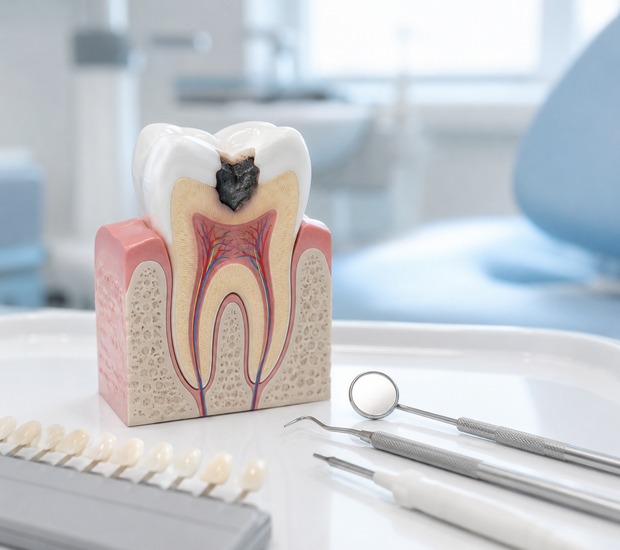
Cavity Treatment Whittier, CA
If you think you may have a cavity, tooth decay, a dark spot, food getting stuck, or tooth sensitivity, it is worth having the tooth evaluated before the problem becomes larger. Cavities can begin quietly and may not always cause pain right away.
At Bailey Family Dental in Whittier, we check for cavities using a dental exam, X-rays when needed, tooth-by-tooth evaluation, and a review of symptoms such as sensitivity, pain with sweets, food trapping, or discomfort when chewing. We explain what we see and what treatment options make sense for the size and depth of the decay.
Personal insight: Many patients assume a cavity only matters once it hurts. In our office, we often find that treating decay earlier can help preserve more tooth structure and may reduce the chance of needing a larger procedure later.
If you are concerned about a cavity, call us at (562) 698-8739 to schedule an evaluation.
What Is a Cavity?
A cavity is an area of tooth damage caused by tooth decay. Decay can start when bacteria and plaque produce acids that weaken the outer enamel layer of the tooth. If the process continues, the damage can move deeper into the tooth.
Not every dark spot or black spot on a tooth, stain, or sensitive tooth is a cavity, and not every cavity hurts. That is why an exam and X-rays may be needed to understand what is actually happening. To understand how decay can progress, visit our Tooth Decay Stages page.
Clinical insight: A cavity is not treated based on appearance alone. We look at the tooth surface, symptoms, X-rays, existing fillings or crowns, bite forces, cavity depth, and how much healthy tooth structure remains before recommending treatment.
“A small cavity and a deep cavity may need very different treatment.”
Find the Cavity Concern That Matches Yours
Tooth decay can show up in different ways. Use this section to find the concern that sounds closest to what you are noticing, then visit the related page for more detail.
Common cavity-related concerns patients may notice include:
- A tooth hurts with sweets: Sensitivity to sweets can sometimes happen with cavities, exposed dentin, worn areas, or other tooth problems. Read our related blog on Why Do My Teeth Hurt When I Eat Sweets?
- Cold sensitivity: Cold sensitivity can come from a cavity, gum recession, cracks, worn enamel, or nerve irritation. Learn more on our Tooth Sensitivity to Cold page.
- A dark spot or black spot: A dark area on a tooth may be staining, tartar, an old filling margin, or decay. Read our related blog on Is a Black Spot on a Tooth Always a Cavity?
- Food getting stuck or floss catching: Food trapping or floss catching may be related to spacing, gum changes, old dental work, or decay between teeth. Learn more on our Cavities Between Teeth page.
- An old filling or crown feels different: Decay can sometimes develop around older dental work. If a filling or crown has a rough edge, dark margin, food trap, or sensitivity, visit our Cavity Under a Filling or Crown page.
- A cavity near the gumline: Gum recession, exposed root surfaces, dry mouth, and age-related changes can increase the risk of cavities near the gumline. Visit our Root Cavities Near the Gumline page.
- Cavities keep coming back: Frequent cavities can be related to dry mouth, diet habits, plaque patterns, gum recession, or old dental work. Read our related blog on Why Do I Keep Getting Cavities?
- Tooth pain or pain when chewing: Pain can mean the decay is deeper, but it can also come from cracks, bite trauma, infection, or other problems. Visit our Tooth Pain page if pain is your main concern.
Not every symptom means you have a cavity, but repeated sensitivity, food trapping, visible changes, or tooth pain should be evaluated.
How a Dentist Checks for Cavities
A cavity evaluation may include a visual exam, review of symptoms, dental X-rays, checking around old fillings or crowns, and looking for soft, weakened, or stained areas of tooth structure. The goal is to understand whether decay is present and how far it has progressed.
X-rays are especially important for cavities between teeth or decay under existing dental work, because those areas may not be easy to see from the outside. For more detail, read our blog on Why You Need Dental X-Rays for a Checkup. For routine visits, visit our Dental Cleaning and Examinations page.
Clinical insight: We do not recommend a filling just because a tooth looks dark. We look at whether the tooth is stained, weakened, cavitated, sensitive, changing, or showing decay on X-rays.
Cavity Treatment Options
Cavity treatment depends on the size, depth, location, symptoms, and remaining tooth structure. The goal is to remove decay, preserve as much healthy tooth as possible, and restore the tooth in a way that is predictable.
Cavity treatment may include:
- Very early enamel changes: Some early enamel changes may be monitored with prevention, fluoride guidance, diet changes, and improved home care. Read our related blogs on Can a Cavity Go Away on Its Own? and Does a Cavity Always Need a Filling?
- Small to moderate cavities: A tooth-colored filling may be appropriate when enough healthy tooth structure remains. Visit our Composite Fillings page.
- Filling material choices: Tooth-colored and silver fillings differ in appearance, bonding, and how they are used. Read our related blog on Tooth-Colored Fillings vs Silver Fillings.
- Larger cavities: If a cavity is too large for a simple filling, an inlay, onlay, or crown may be considered. Visit our Large Cavity: Filling vs. Crown vs. Root Canal page.
- Weakened teeth: If decay has removed a lot of tooth structure, a crown may be recommended to help protect the tooth. Visit our Dental Crowns page.
- Deep decay near the nerve: If decay reaches or irritates the nerve, root canal treatment may be needed before the tooth is restored. Visit our Do I Need a Root Canal? page.
- Teeth that cannot be predictably restored: If decay has damaged too much tooth structure, extraction may be discussed. Visit our Tooth Extraction page.
At Bailey Family Dental in Whittier, we explain what we are seeing and why a specific treatment option may be recommended.
“The right cavity treatment depends on how much healthy tooth structure is still left.”
What If the Cavity Is Large or Deep?
A large cavity can weaken the tooth and may need more than a simple filling. If the decay is close to the nerve, the tooth may become sensitive, painful, or infected. In those cases, the treatment decision may involve a filling, crown, root canal treatment, or extraction depending on the findings.
This page gives the broad overview. For a deeper treatment comparison, visit our Large Cavity: Filling vs. Crown vs. Root Canal page. If you are wondering whether it is safe to wait, read our blog on How Long Can You Wait to Fill a Cavity?
Clinical insight: A deep cavity is not automatically a root canal, but it should be evaluated carefully. We look at symptoms, X-rays, remaining tooth structure, nerve involvement, and whether the tooth can be restored predictably.
Preventing Future Cavities
Preventing cavities is not only about brushing harder. Cavity risk can be affected by plaque, diet frequency, dry mouth, medications, gum recession, old dental work, enamel strength, and how often a patient receives preventive care.
For daily home care guidance, visit our Oral Hygiene Basics page. For routine prevention, visit our Preventative Dental Care page. If dry mouth is a concern, visit our Dry Mouth page.
Children and cavity-prone patients may also benefit from prevention-focused options such as sealants when appropriate. Learn more on our Dental Sealants page.
Personal insight: When a patient keeps getting cavities, the answer is rarely just “brush more.” We look for patterns, including dry mouth, frequent snacking, difficult-to-clean areas, old restorations, and gum recession. For more detail, read our blogs on Why Do I Keep Getting Cavities? and Can Dry Mouth Cause Cavities?
Why Choose Bailey Family Dental for Cavity Treatment in Whittier?
Bailey Family Dental is located in Whittier and helps patients evaluate cavities, tooth sensitivity, tooth pain, old fillings, and decay around existing dental work. Our goal is to explain what we see clearly so patients understand whether a tooth needs monitoring, a filling, an inlay or onlay, a crown, root canal treatment, or another option.
During a cavity evaluation, we may use a visual exam, digital X-rays, photos when helpful, and a tooth-by-tooth review of symptoms. We also look at bite forces, old restorations, dry mouth, gum recession, and cavity risk factors so the recommendation is based on the whole situation, not just one dark spot or one sensitive tooth.
Clinical insight: Whittier patients have many dental offices to choose from. Our approach is to be clear, practical, and conservative when possible, while still treating decay before it becomes more painful or more difficult to restore.
See our Google reviews: Read what patients are saying about Bailey Family Dental
Questions Answered on This Page
Q. Which cavity concern matches mine?
Q. How does a dentist check for cavities?
Q. What are cavity treatment options?
Q. What if the cavity is large or deep?
Q. How can I prevent future cavities?
People Also Ask
Q. Do cavities always need fillings?
Q. How does a dentist check for cavities?
Frequently Asked Questions
Q. What are the first signs of a cavity?
A. Early signs may include sensitivity to sweets, cold sensitivity, food getting stuck, a rough area, a dark spot, or discomfort when chewing. Some cavities do not cause symptoms at first.
Q. Can I have a cavity without pain?
A. Yes. A cavity may not hurt in the early stages. Pain is more likely when decay becomes deeper, irritates the nerve, or weakens the tooth.
Q. Does every cavity need a filling?
A. Not always. Very early enamel changes may sometimes be managed with prevention and monitoring, but a true hole or cavitated area usually needs a restoration such as a filling or other treatment.
Q. What happens if a cavity is not treated?
A. Untreated decay can get larger, weaken the tooth, cause pain, reach the nerve, lead to infection, or eventually require more involved treatment such as a crown, root canal, or extraction.
Q. How does a dentist know if decay is deep?
A. A dentist may use an exam, X-rays, symptoms, and the condition of the tooth to estimate how far decay has progressed and whether the nerve or tooth structure may be at risk.
Q. Can a cavity cause sensitivity to sweets or cold?
A. Yes, cavities can sometimes cause sensitivity to sweets or cold. However, sensitivity can also come from gum recession, cracks, worn enamel, exposed dentin, or nerve irritation, so an exam is needed.
Q. When should I see a dentist for a possible cavity?
A. You should schedule an evaluation if you notice repeated sensitivity, tooth pain, food trapping, a dark spot, a broken filling, a rough area, or if you have been told a cavity may be present.
Reviewed by Brian Choi, DMD
General Dentist at Bailey Family Dental in Whittier, CA
Reviewed: August 2026
Schedule a Cavity Evaluation in Whittier
Cavities are easier to treat when they are found earlier. Bailey Family Dental can evaluate your tooth, explain what we are seeing, and recommend the right next step based on the size and depth of the decay.
Call Bailey Family Dental in Whittier at 562-698-8739 to schedule a cavity evaluation.