What Happens If You Do Not Fill a Cavity?
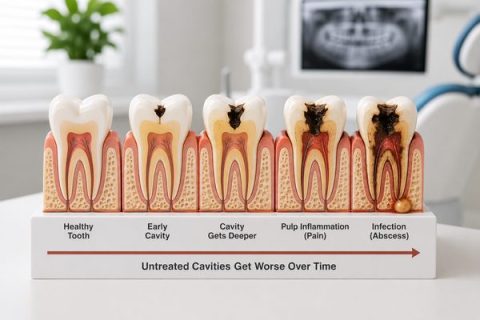
If you do not fill a cavity that needs treatment, the decay can continue to spread deeper into the tooth. A small cavity may eventually become a larger cavity, cause tooth pain, weaken the tooth, reach the nerve, or lead to infection.
At Bailey Family Dental in Whittier, we evaluate cavities by checking the tooth, symptoms, X-rays when appropriate, and how much healthy tooth structure remains. The goal is to treat tooth decay before it becomes more painful, more complicated, or harder to repair. To understand why X-rays matter, read our blog on Why You Need Dental X-Rays for a Checkup.
Quick answer: If you do not fill a cavity that has already damaged the tooth, the decay may continue to grow. Over time, an untreated cavity can lead to a larger filling, crown, root canal treatment, infection, broken tooth, or tooth extraction.
What Happens If You Do Not Fill a Cavity?
A cavity is caused by tooth structure breaking down from bacteria, plaque, and acid. Once decay has softened, opened, or damaged the tooth, the missing structure does not grow back on its own. For more detail, read our blog on Can a Cavity Go Away on Its Own?
If the cavity is not treated, bacteria can continue to move deeper into the tooth. The longer the decay is active, the more tooth structure may be lost.
For a broader overview of how cavities are diagnosed and treated, visit our Cavity Treatment page.
A Small Cavity Can Become a Larger Cavity
In the early stages, a cavity may be small and easier to repair. A small to moderate cavity can often be treated with a tooth-colored filling when enough healthy tooth remains.
If the cavity is left alone, the decay can spread into deeper tooth structure. A larger cavity may require a larger filling, an inlay, an onlay, or a crown if the tooth becomes too weak for a simple filling.
Learn more about filling options on our Composite Fillings page.
The Tooth May Start Hurting
Many cavities do not hurt at first. A tooth may feel normal while decay is still in the enamel or outer dentin. This is why some patients are surprised when a cavity is found during a dental exam or on X-rays.
As the cavity gets deeper, symptoms may begin. These can include sweet sensitivity, cold sensitivity, pain when biting, food trapping, or a toothache that keeps returning. If sweets trigger discomfort, read our blog on Tooth Pain When Eating Sweets.
If you are unsure what symptoms can point to decay, read our blog on Signs You May Have a Cavity Even Without Pain.
Decay Can Reach the Nerve
If a cavity spreads deep enough, it can reach the nerve inside the tooth. When this happens, the tooth may become painful, sensitive for a long time after cold or heat, or painful without any trigger.
Once the nerve is involved, a filling alone may not be enough. The tooth may need root canal treatment before it can be restored.
To understand how tooth decay moves from early damage to deeper infection risk, visit our Tooth Decay Stages page.
The Tooth Can Become Infected
An untreated cavity can eventually allow bacteria to reach the inside of the tooth. This can lead to infection, swelling, a gum bump, bad taste, pain, or pressure near the tooth.
A dental infection should not be ignored. If swelling, severe pain, fever, difficulty swallowing, or facial swelling occurs, seek prompt dental or medical care.
If symptoms are severe or worsening, visit our Emergency Dentist page.
The Tooth Can Break or Weaken
As decay spreads, it removes healthy tooth structure. A tooth with a large cavity may become weak, especially if the cavity is wide, deep, or located under a large old filling.
Eventually, part of the tooth may chip, crack, or break. If too much structure is lost, a filling may no longer be strong enough to repair the tooth.
If you are comparing treatment options for a larger cavity, visit our Large Cavity: Filling vs. Crown vs. Root Canal page.
You May Need a Crown Instead of a Filling
A filling repairs a smaller area of damaged tooth structure. A crown may be needed when the tooth has lost too much structure or needs more coverage and protection.
This can happen when a cavity becomes large, when a tooth already has a large filling, or when the remaining tooth structure is too weak to support a simple filling.
In many cases, treating a cavity earlier can help preserve more natural tooth structure and may reduce the chance that a larger restoration is needed.
You Could Eventually Lose the Tooth
If an untreated cavity becomes very deep, infected, fractured, or structurally hopeless, the tooth may not be restorable. In that situation, extraction may be discussed.
Not every untreated cavity leads to tooth loss, but waiting too long can reduce the number of treatment options available. The earlier a cavity is evaluated, the more likely the tooth can be repaired conservatively.
If a tooth cannot be saved, visit our Tooth Extraction page to learn more about what may happen next.
What If the Cavity Does Not Hurt?
A cavity can still need treatment even if there is no pain. Pain is not the only sign dentists use to decide whether a cavity needs a filling or another restoration.
A dentist may look at the size, depth, location, X-ray appearance, softness of the tooth, symptoms, cleaning access, and whether the cavity appears active.
If you are wondering whether every cavity needs treatment right away, read our blog on Does a Cavity Always Need a Filling?
Can You Wait to Fill a Cavity?
Some very early enamel changes may be monitored, but a true cavity that has softened or broken down tooth structure should usually be treated before it gets larger.
There is no single safe amount of time to wait. The right timing depends on the cavity size, depth, location, symptoms, and risk of progression.
For more detail, read our blog on How Long Can You Wait to Fill a Cavity?
What About Cavities Between Teeth?
Cavities between teeth can grow quietly because they are hard to see without X-rays. By the time food trapping, floss catching, sweet sensitivity, or pain appears, the cavity may already be deeper than expected.
If a cavity between teeth has broken through enamel, waiting can allow it to spread farther into the tooth. Learn more on our Cavities Between Teeth page.
What About Root Cavities Near the Gumline?
Root cavities near the gumline can be especially important to evaluate because exposed root surfaces are softer than enamel. When the root surface is exposed, decay may spread faster than patients expect.
If a root cavity becomes soft, dark, rough, or open, it usually needs treatment. Waiting too long may make the area harder to restore and harder to keep clean afterward.
For more detail, visit our Root Cavities Near the Gumline page.
What About Decay Under a Filling or Crown?
Decay under or around an old filling or crown usually does not stop on its own. If bacteria are getting under a leaking edge or crown margin, the cavity may continue spreading underneath the dental work.
This type of decay can be difficult to judge from the outside because the tooth may look mostly normal. Warning signs may include food trapping, floss catching, odor, bad taste, cold sensitivity, a dark edge, or a loose filling or crown.
Learn more on our Cavity Under a Filling or Crown page.
When to See a Dentist
You should schedule a dental visit if you were told you have a cavity, notice a dark spot, feel a rough area, have food getting stuck, feel sensitivity, or are worried an area is getting worse. If you are unsure whether a dark spot is decay, read our blog on Is a Black Spot on a Tooth Always a Cavity? If dry mouth or frequent cavities are part of the concern, read our blogs on Can Dry Mouth Cause Cavities? and Why Do I Keep Getting Cavities?
You should also keep routine dental exams even if nothing hurts. A dental cleaning and examination can help find cavities earlier, before they become painful or more complicated.
If you are in Whittier and have a cavity that has not been filled yet, call Bailey Family Dental at 562-698-8739 to schedule an evaluation. We can help determine whether the cavity should be treated now or whether it can be monitored briefly.
Reviewed by Brian Choi, DMD
General Dentist at Bailey Family Dental in Whittier, CA
Updated: September 2026
Have a cavity that still needs treatment?
An untreated cavity can grow, cause pain, weaken the tooth, or lead to more complicated treatment. At Bailey Family Dental in Whittier, we can evaluate the tooth and explain whether a filling or another treatment option may be needed.
We’re currently accepting new patients.
Book an Appointment