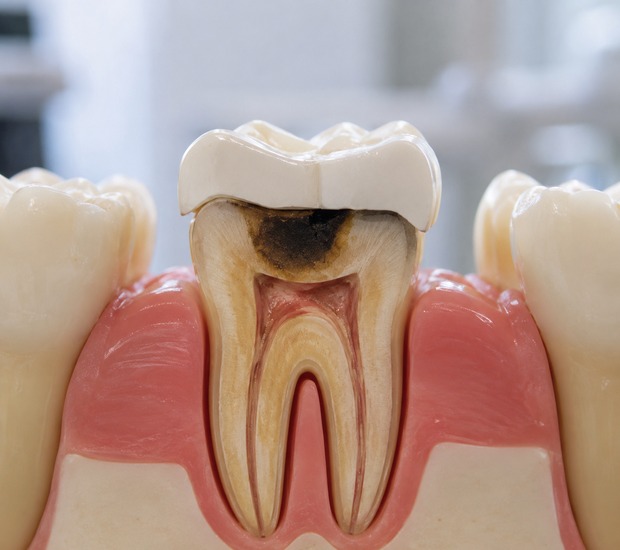
Cavity Under a Filling or Crown Whittier, CA
If an old filling or crown feels different, traps food, catches floss, smells bad, or becomes sensitive, decay may be forming around the edge of the dental work. This is often called recurrent decay.
At Bailey Family Dental in Whittier, we check old fillings and crowns carefully to see whether the problem is staining, an open margin, a loose restoration, a crack, or decay under the dental work.
Clinical insight: A tooth with an old filling or crown can look mostly normal from the outside while decay is starting underneath or along the edge. For more detail about why X-rays matter, read our blog on Why You Need Dental X-Rays for a Checkup.
If you are worried about decay under an old filling or crown, call Bailey Family Dental at (562) 698-8739 to schedule an evaluation.
What Is a Cavity Under a Filling or Crown?
A cavity under a filling or crown means bacteria have reached tooth structure around or beneath existing dental work. The filling or crown may still be in place, but the tooth near the edge may be breaking down.
This is different from a brand-new cavity on an untouched tooth. With recurrent decay, the dentist has to evaluate both the tooth and the old restoration. The key question is whether the old filling or crown still seals well and whether the remaining tooth can support a predictable repair.
For the broader topic of how cavities are diagnosed and treated, visit our Cavity Treatment page. To understand how decay can progress, visit our Tooth Decay Stages page.
Why Recurrent Decay Needs a Different Evaluation
Recurrent decay needs a different evaluation because the dentist is not only checking for a cavity. The old filling or crown also has to be checked for open margins, leakage, looseness, cracks, food traps, and whether it can still protect the tooth.
This can make the problem harder to detect. The filling or crown may hide part of the tooth, and the outside of the restoration may still look mostly normal. The important question is not only whether decay is present, but whether the old dental work is still sealing properly and whether the tooth underneath can support a new restoration.
Clinical insight: Recurrent decay often requires more judgment than a small first-time cavity. We have to evaluate the old restoration, the amount of remaining tooth structure, the nerve, the bite, and whether the tooth can be repaired in a predictable way.
For general cavity diagnosis and treatment, visit our Cavity Treatment page. For tooth-colored filling material, visit our Composite Fillings page.
“Old dental work can look okay from the outside while decay is starting at the edges.”
Why Decay Can Form Under Fillings and Crowns
Fillings and crowns can protect and restore teeth, but they are not immune to future problems. Over time, edges can wear, margins can open, cement can wash out, cracks can form, and plaque can collect around areas that are hard to clean.
Recurrent decay is more likely when the area traps food or plaque, the patient has dry mouth, there is frequent snacking or sipping, the bite is heavy, or an old restoration is leaking or breaking down.
Common reasons decay develops around old dental work include:
- Leaking filling margins: Small gaps can allow bacteria and fluids to collect around the edge.
- Crown margin breakdown: A crown edge may no longer seal well if cement washes out or the tooth changes.
- Food trapping: Open contacts or rough edges can trap food between teeth.
- Cracks or fractures: Cracks can allow bacteria to enter deeper areas of the tooth.
- Dry mouth: Less saliva can increase cavity risk around teeth and restorations.
- Difficulty cleaning: Crowded areas, gum recession, and old dental work can make plaque control harder.
If food gets stuck around a filling or crown, read our related blog on Why Does Food Get Stuck Between My Teeth? For prevention guidance, visit our Preventative Dental Care page. If dry mouth is a concern, read our blog on Can Dry Mouth Cause Cavities?
Signs of a Cavity Under a Filling or Crown
Decay under old dental work may not hurt at first. A patient may notice sensitivity, food trapping, a rough edge, floss shredding, a bad taste, an odor, a dark line, or a filling or crown that feels different than before.
Symptoms can also overlap with cracks, bite problems, gum recession, exposed root surfaces, or old restorations that are loose. An exam and X-rays can help narrow down the cause.
Possible signs include:
- Food catching near old dental work: Food trapping may suggest an open contact, rough edge, or broken restoration.
- Floss tearing or catching: Rough margins, decay, calculus, or overhangs can cause floss to shred.
- Sweet or cold sensitivity: Sensitivity may happen when decay reaches deeper tooth structure.
- Pain when biting: Biting pain may suggest cracks, deep decay, infection, or bite trauma.
- Dark edge around a filling or crown: This may be staining, shadowing, exposed tooth structure, or decay.
- Loose filling or crown: A loose restoration can allow bacteria to collect underneath.
What Patients Usually Notice First
Many patients do not realize there is decay under an old filling or crown right away. The tooth may look normal in the mirror, and it may not hurt all the time.
Instead, the first warning sign is often something small that keeps happening in the same area. Food may get stuck near the crown or filling. Floss may catch or shred. The tooth may feel sensitive to cold or sweets. There may be a bad taste, odor, rough edge, or a feeling that the old dental work does not feel the same as before.
Clinical insight: When a patient says, “something feels off around this old crown or filling,” that can be an important clue. Recurrent decay is often easier to treat when it is found before the tooth becomes painful, infected, or too weak to restore predictably.
If decay under a filling or crown is causing swelling, severe pain, fever, facial swelling, or difficulty opening the mouth, it should be evaluated promptly. These symptoms may require care from an emergency dentist.
If cold sensitivity is your main issue, visit our Tooth Sensitivity to Cold page. If sweets trigger pain, read our blog on Why Do My Teeth Hurt When I Eat Sweets? If tooth pain is the main concern, visit our Tooth Pain page.
How Dentists Find Decay Under a Filling or Crown
Decay under a filling or crown can be challenging to evaluate because dental materials may hide part of the tooth. A dentist may use a visual exam, X-rays, margin checks, bite testing, symptom review, and evaluation of the surrounding gum and tooth structure.
X-rays can help show decay around old fillings, decay under crown margins, bone changes near a root, and areas between teeth that are not easy to see directly. However, X-rays do not show everything, especially under some crown materials or very dense restorations.
Clinical insight: Sometimes the full extent of decay is not known until the old filling or crown is removed. A tooth may look repairable at first, but deeper decay can change the final recommendation.
For more detail about why X-rays matter, read our blog on Why You Need Dental X-Rays for a Checkup. For routine evaluation and cleanings, visit our Dental Cleaning and Examinations page.
“Decay around old dental work can be small at the edge but deeper underneath.”
How a Cavity Under a Filling or Crown Is Treated
Treatment depends on how much decay is present under or around the old dental work, how much healthy tooth structure remains, whether the nerve is involved, and whether the existing filling or crown can be repaired or needs to be replaced. Some teeth may only need replacement of the old filling. Others may need crown replacement, root canal treatment, extraction, or a different plan if the decay has spread deeper underneath the restoration.
The first step is understanding the source of the problem. A small area of recurrent decay around a filling may be very different from deep decay under a crown that has reached the nerve or weakened the remaining tooth.
Treatment may depend on:
- Depth of decay: Shallow decay may be treated differently than decay close to the nerve.
- Remaining tooth structure: The tooth needs enough support to hold a new restoration.
- Condition of the old filling or crown: Loose, leaking, broken, or poorly sealed dental work may need replacement.
- Nerve health: Lingering pain, swelling, or infection may mean root canal treatment is needed.
- Cracks or fractures: Cracks can change whether the tooth can be restored predictably.
- Long-term prognosis: The goal is to choose a treatment that can function safely over time.
For broader cavity treatment options, visit our Cavity Treatment page. If you are unsure whether a cavity always needs treatment, read our blog on Does a Cavity Always Need a Filling? If the cavity is large, visit our Large Cavity: Filling vs. Crown vs. Root Canal page.
When an Old Filling May Be Replaced
If decay is limited and enough healthy tooth structure remains, the old filling may be removed, the decay cleaned out, and a new filling placed. This may be possible when the tooth is not cracked, the decay is not too deep, and the tooth can support the new restoration.
Replacing a filling is not always as simple as swapping one filling for another. Once the old filling is removed, the remaining tooth may be weaker than expected, especially if decay has spread underneath or if the filling was already very large.
Clinical insight: A small-looking edge leak can sometimes lead to a much larger restoration after the old filling and decay are removed. We try to explain this before treatment when the risk is visible on the exam or X-ray.
For tooth-colored filling information, visit our Composite Fillings page.
When a Crown May Need to Be Replaced
A crown may need to be replaced if decay has formed around the crown margin, if the crown is loose, if the edge no longer seals well, or if the tooth underneath has changed. Sometimes the crown itself looks intact, but the tooth under the crown is the problem.
If the decay is limited and the tooth is still strong enough, a new crown may be possible. If decay extends deep below the gumline, reaches the nerve, or leaves too little tooth structure, the treatment may become more involved.
A crown may need replacement when:
- The crown margin is leaking: Bacteria can collect around an edge that no longer seals well.
- The crown is loose: Movement can allow fluids and bacteria to enter underneath.
- Decay is visible near the crown edge: A dark or soft area near the margin may need evaluation.
- Food traps around the crown: Open contacts or rough edges can make cleaning harder.
- The tooth hurts or feels different: Symptoms may suggest deeper decay, nerve irritation, or bite issues.
For more detail about crown treatment, visit our Dental Crowns page.
“The question is not only whether the filling or crown failed. It is whether the tooth underneath can still be restored predictably.”
When Root Canal Treatment May Be Needed
Root canal treatment may be needed if decay under a filling or crown reaches the nerve, causes infection, or creates symptoms that suggest the nerve is no longer healthy. A tooth with recurrent decay may feel normal at first, but symptoms can develop as decay gets deeper.
Possible warning signs include lingering cold sensitivity, spontaneous pain, swelling, a gum pimple, pain when biting, or pain that wakes a patient up at night. X-rays may also show changes near the root if infection has developed.
Clinical insight: A crown protects the outside of the tooth, but it does not treat an infected nerve. If decay under a crown reaches the nerve, root canal treatment may be needed before the tooth can be restored.
If nerve involvement is a concern, visit our Do I Need a Root Canal? page or our Root Canal Treatment page.
When the Tooth May Not Be Restorable
Sometimes decay under a filling or crown destroys too much tooth structure for the tooth to be restored predictably. This can happen if decay extends far below the gumline, if the root is fractured, if there is not enough tooth to hold a crown, or if the tooth has a poor long-term prognosis.
In those cases, extraction may be discussed. This decision is not based on the filling or crown alone. It depends on whether the remaining tooth can be rebuilt in a way that is stable, cleanable, functional, and safe over time.
Clinical insight: Saving a tooth is ideal when the tooth can be restored predictably. When the remaining structure is too compromised, replacing the tooth may be a better long-term plan than repeatedly patching a failing tooth.
To understand what can happen when decay is not treated in time, read our blog on What Happens If You Do Not Fill a Cavity? If a tooth cannot be predictably restored, visit our Tooth Extraction page to learn more.
Can Decay Around Fillings and Crowns Be Prevented?
Not all recurrent decay can be prevented, but risk can often be reduced. Daily cleaning, regular exams, X-rays when appropriate, dry mouth management, and checking old dental work can help catch problems before they become larger.
Patients who frequently get cavities, have dry mouth, snack often, or have many older restorations may need a more specific prevention plan.
Helpful prevention steps may include:
- Cleaning around crown and filling edges: Plaque often collects near margins and between teeth.
- Flossing or interdental cleaning: Cleaning between teeth can reduce plaque around contacts and restorations.
- Managing dry mouth: Dry mouth can increase cavity risk around natural teeth and dental work.
- Reducing frequent snacking or sipping: Repeated acid exposure can raise cavity risk.
- Regular dental exams: Old fillings and crown margins can be checked before symptoms develop.
- X-rays when appropriate: X-rays may help detect decay that is hidden under or around older restorations.
For prevention information, visit our Preventative Dental Care page, our Oral Hygiene Basics page, and our Dry Mouth page. If cavities keep coming back around older dental work, read our blog on Why Do I Keep Getting Cavities?
Why Choose Bailey Family Dental for Decay Under Fillings or Crowns in Whittier?
Bailey Family Dental is located in Whittier and helps patients evaluate old fillings, old crowns, recurrent decay, food trapping, floss catching, sensitivity, loose dental work, and deep decay that may affect the nerve.
Dr. Brian Choi has practiced general dentistry since 2011 and evaluates recurrent decay, failing fillings, loose crowns, tooth pain, food trapping, and restorative options for patients in Whittier. Recommendations are based on the exam, X-rays when needed, symptoms, remaining tooth structure, and long-term prognosis.
We focus on explaining what we see clearly. If a filling or crown appears to be leaking, breaking down, or hiding decay underneath, we discuss the likely cause, what the X-rays show, and whether the tooth may need a new filling, crown, root canal treatment, extraction, or another option.
Clinical insight: Patients often worry that a crown or filling should last forever. Dental work can last a long time, but the tooth around it still needs maintenance, cleaning, and periodic evaluation.
See our Google reviews: Read what patients are saying about Bailey Family Dental
Questions Answered on This Page
Q. What is a cavity under a filling or crown?
Q. Why does decay form under fillings and crowns?
Q. What are signs of decay under old dental work?
Q. What do patients usually notice first with decay under old dental work?
Q. How do dentists find decay under a filling or crown?
Q. How is a cavity under a filling or crown treated?
Q. When does a crown need to be replaced?
Q. When is a tooth not restorable?
People Also Ask
Q. When does a tooth need a crown?
Frequently Asked Questions
Q. What is recurrent decay?
A. Recurrent decay means a cavity has developed around, under, or next to existing dental work, such as an old filling, crown, or bonding. It often starts near an edge or margin where bacteria and plaque can collect.
Q. Can you get a cavity under a filling?
A. Yes. Decay can form around or under an old filling if the edge leaks, the filling breaks down, food traps nearby, or plaque collects around the restoration.
Q. Can you get a cavity under a crown?
A. Yes. A crown covers the tooth, but the tooth under the crown can still develop decay near the crown margin or underneath if bacteria enter around an edge that no longer seals well.
Q. How do dentists know if there is decay under a crown?
A. A dentist may use an exam, X-rays, margin checks, symptom review, bite testing, and evaluation of the gumline around the crown. Sometimes the full extent of decay is not known until the crown is removed.
Q. Can a cavity under a crown be fixed without replacing the crown?
A. Sometimes a small area near a crown margin may be repaired, but many cases require crown removal or replacement to clean out decay properly and restore the tooth. The right option depends on the location and depth of decay.
Q. Does decay under a filling or crown always hurt?
A. No. Recurrent decay may not hurt early. Symptoms are more likely when decay gets deeper, reaches sensitive tooth structure, affects the nerve, or causes infection.
Q. Can decay under a crown lead to extraction?
A. Yes. If decay under a crown destroys too much tooth structure, extends too far below the gumline, or leaves the tooth unable to support a predictable restoration, extraction may be discussed.
Reviewed by Brian Choi, DMD
General Dentist at Bailey Family Dental in Whittier, CA
Reviewed: August 2026
Worried About Decay Under an Old Filling or Crown?
Decay under an old filling or crown can be hard to see and may not hurt early. Bailey Family Dental can evaluate the tooth, review X-rays when needed, and explain whether repair, replacement, root canal treatment, extraction, or another option may be appropriate.
Call Bailey Family Dental in Whittier at 562-698-8739 to schedule an evaluation.