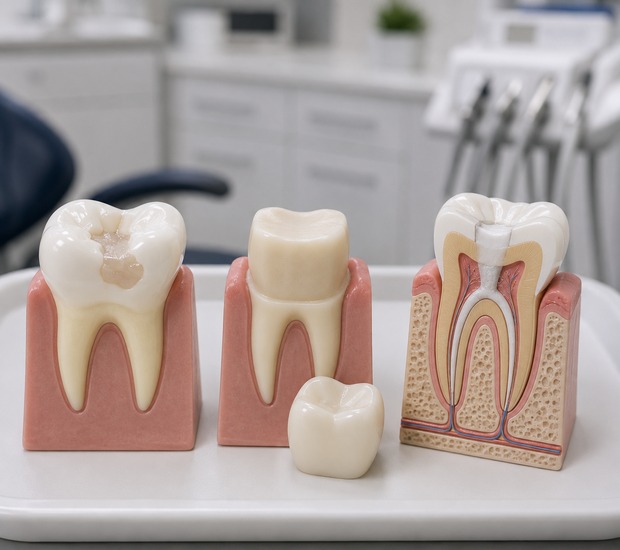
Large Cavity: Filling vs. Crown vs. Root Canal Whittier, CA
A large cavity does not automatically mean the same treatment for every tooth. Some large cavities may still be restored with a filling, while others may need an inlay, onlay, crown, root canal treatment, or extraction depending on how much tooth structure remains and whether the nerve is involved.
At Bailey Family Dental in Whittier, we evaluate large cavities with an exam, X-rays when needed, symptom review, bite evaluation, and a careful look at the remaining tooth structure. The goal is to recommend the most predictable option for that specific tooth.
Clinical insight: The biggest question is not just “how big is the cavity?” It is whether the tooth has enough healthy structure to hold a restoration and whether the nerve is healthy enough to avoid root canal treatment.
If you were told you have a large cavity, call Bailey Family Dental at (562) 698-8739 to schedule an evaluation.
What Does “Large Cavity” Mean?
A large cavity usually means decay has destroyed enough tooth structure that the tooth may need more than a simple repair. It may involve a large chewing surface, decay between teeth, decay under an old filling or crown, a broken cusp, or decay that is close to the nerve.
Large cavities can look very different from patient to patient. One tooth may have a large visible hole but no pain. Another tooth may look only slightly dark from the outside but have deep decay between the teeth on an X-ray.
This page compares the common options for a large cavity. For the broader overview of how cavities are diagnosed and treated, visit our Cavity Treatment page.
“A large cavity is not treated by size alone. The remaining tooth structure and nerve health matter just as much.”
How We Decide Between a Filling, Crown, or Root Canal
The right treatment for a large cavity depends on several factors. A filling repairs missing tooth structure. A crown protects a weakened tooth. Root canal treatment treats the nerve space when the nerve is inflamed, infected, or no longer healthy. These treatments solve different problems.
When evaluating a large cavity, we look at:
- How much healthy tooth structure remains: The tooth needs enough support to hold the restoration.
- How close the decay is to the nerve: Deep decay can irritate or infect the nerve inside the tooth.
- Whether the tooth is cracked or weakened: Cracks, missing cusps, and large old fillings can change the recommendation.
- Symptoms: Lingering cold sensitivity, spontaneous pain, swelling, or pain that wakes a patient up can suggest deeper nerve involvement.
- Bite forces: Back teeth and heavy-biting areas may need more protection than small low-stress areas.
- Long-term predictability: The goal is not just to fill the hole. The goal is to choose a restoration that can function safely over time.
Clinical insight: A large cavity with no symptoms can still be serious. Pain helps guide the diagnosis, but it is not the only factor we use to decide what a tooth needs.
When a Large Cavity May Still Need a Filling
A filling may be appropriate when the cavity is not too deep, the tooth has enough healthy structure remaining, the bite is stable, and the restoration can be placed in a way that seals and supports the tooth predictably.
In general, fillings work best when the tooth is still strong enough to support the repair. If the cavity is large but the cusps are intact and the decay is not close to the nerve, a filling may still be considered.
A filling may be considered when:
- Enough tooth structure remains: The tooth can support a bonded restoration without flexing or breaking.
- The decay is not too close to the nerve: Symptoms and X-rays do not suggest nerve involvement.
- The bite is favorable: The filling will not be under excessive stress.
- The cavity is small to moderate after decay removal: Some cavities look large at first but are more manageable after cleaning out the decay.
- The tooth is not cracked: Cracked or weakened cusps may need more coverage than a filling can provide.
For tooth-colored filling information, visit our Composite Fillings page. If you are wondering whether a cavity always needs a filling, read our blog on Does a Cavity Always Need a Filling?
When an Inlay or Onlay May Be the Middle Option
Sometimes a cavity is too large for a simple filling but does not need a full crown. In those cases, an inlay or onlay may be discussed. These restorations can help rebuild part of the tooth while preserving more natural tooth structure than a full crown in selected cases.
An onlay may be considered when one or more cusps need coverage, but the entire tooth does not need to be covered. The final recommendation depends on the amount of remaining tooth, the bite, the cavity size, and whether the tooth has cracks or nerve symptoms.
Clinical insight: Inlays and onlays can be helpful when a regular filling is not strong enough, but a full crown may be more than the tooth needs. They are not right for every large cavity, but they are worth considering in the right case.
For more detail, visit our Dental Inlays and Onlays page.
“A filling repairs a hole. A crown protects a weakened tooth. A root canal treats the nerve.”
When a Large Cavity May Need a Crown
A crown may be recommended when a large cavity has weakened the tooth enough that a filling would not be predictable. This can happen when too much tooth structure is missing, a cusp is cracked or broken, the tooth already has a very large filling, or the tooth needs protection after root canal treatment.
A crown covers and protects the remaining tooth structure. It does not treat an infected nerve by itself. If the nerve is healthy, a crown may be enough. If the nerve is inflamed or infected, root canal treatment may also be needed before the tooth is restored.
A crown may be recommended when:
- Too much tooth structure is missing: A filling may not have enough support to hold up.
- A cusp is cracked or undermined: The tooth may need coverage to reduce the risk of fracture.
- The cavity is under or around an old large filling: Replacing the filling may leave the tooth too weak.
- The tooth has pain when biting from structural weakness: The tooth may need more protection than a filling can provide.
- The tooth has had root canal treatment: Many back teeth need a crown after root canal treatment to reduce fracture risk.
For more detail, visit our Dental Crowns page.
When a Large Cavity May Need a Root Canal
Root canal treatment may be needed when decay reaches the nerve space, causes infection, or creates symptoms that suggest the nerve is no longer healthy. A root canal does not make the tooth stronger by itself. It treats the inside of the tooth so the tooth can then be restored.
Some teeth with deep cavities can still avoid root canal treatment, while others need it because the nerve is inflamed or infected. The decision depends on symptoms, X-rays, testing, and what we find clinically.
Root canal treatment may be discussed when:
- Decay is very close to or into the nerve: Deep decay can irritate or contaminate the nerve space.
- Pain lingers after cold: Lingering cold sensitivity can suggest deeper nerve inflammation.
- There is spontaneous pain: Pain that starts without a clear trigger can be a warning sign.
- There is swelling or a gum pimple: This may suggest infection or abscess formation.
- The tooth hurts to bite: Biting pain may be related to infection, cracks, deep decay, or bite trauma.
- The X-ray shows signs near the root: Changes around the root can suggest nerve infection or inflammation.
For more detail, visit our Do I Need a Root Canal? page or our Root Canal Treatment page.
When a Large Cavity May Not Be Restorable
Sometimes a large cavity has destroyed too much tooth structure for the tooth to be restored predictably. In those cases, extraction may be discussed. This is usually considered when the tooth cannot safely support a filling, crown, or root canal restoration long term.
A tooth may also be difficult to save if decay extends far below the gumline, if the root is fractured, if there is not enough tooth structure to hold a crown, or if the tooth has a poor long-term prognosis.
Clinical insight: The goal is not to save a tooth at any cost. The goal is to decide whether the tooth can be restored in a way that is stable, functional, cleanable, and predictable. To understand how untreated decay can progress, read our blog on What Happens If You Do Not Fill a Cavity?
If a tooth cannot be predictably restored, visit our Tooth Extraction page to learn more.
“The best treatment is the one that gives the tooth the most predictable long-term result.”
Large Cavity Treatment Comparison
A filling, inlay, onlay, crown, and root canal are not interchangeable. Each option solves a different problem. The final recommendation depends on the exam, X-rays, symptoms, remaining tooth structure, bite forces, and nerve health.
| Option | What it mainly does | May be considered when | Important limitation |
|---|---|---|---|
| Filling | Repairs a cavity or missing tooth structure | Enough healthy tooth remains and the cavity is not too deep | May not protect a weakened or cracked tooth |
| Inlay or Onlay | Rebuilds a larger portion of the tooth | A regular filling may be too large, but a full crown may not be necessary | Not ideal if the tooth needs full coverage or has nerve infection |
| Crown | Covers and protects a weakened tooth | Large structure loss, cracked cusps, large old fillings, or post-root-canal protection | Does not treat an infected nerve by itself |
| Root Canal | Treats the infected or inflamed nerve space | Decay reaches the nerve, infection develops, or nerve symptoms are present | Usually still needs a final restoration, often a crown on back teeth |
| Extraction | Removes a tooth that cannot be predictably restored | Too much structure is lost or the tooth has a poor long-term prognosis | The missing tooth may need replacement planning |
Clinical insight: A crown and a root canal answer different questions. A crown answers, “Is the tooth strong enough?” A root canal answers, “Is the nerve healthy?” Some teeth need one, some need both, and some need neither.
Symptoms That Can Change the Recommendation
Symptoms do not tell the whole story, but they can strongly influence the diagnosis. A large cavity with no symptoms may still need treatment, while a painful tooth may need a different approach than a tooth that only has mild sensitivity.
Tell the dentist if you notice:
- Lingering cold sensitivity: Sensitivity that lasts after the cold is gone may suggest nerve irritation.
- Sweet sensitivity: This can happen when decay reaches deeper tooth structure.
- Pain when biting: Biting pain can be related to cracks, deep decay, infection, or a high bite.
- Spontaneous pain: Pain without a trigger can suggest a more serious nerve problem.
- Swelling or gum drainage: This may suggest infection and should be evaluated promptly.
- Food trapping: Food getting stuck may point to open contacts, broken tooth structure, or decay between teeth.
If tooth pain is the main concern, visit our Tooth Pain page. If cold sensitivity is the main issue, visit our Tooth Sensitivity to Cold page. If sweets trigger pain, read our blog on Why Do My Teeth Hurt When I Eat Sweets? If food trapping is the main issue, visit our Cavities Between Teeth page.
What Happens During a Large Cavity Evaluation?
During a large cavity evaluation, we examine the tooth, review symptoms, check the bite, and take X-rays when needed. We look for decay depth, cracks, old filling breakdown, decay around crowns, gumline involvement, and how much healthy tooth structure remains.
We may also discuss cavity risk factors such as dry mouth, diet frequency, plaque buildup, gum recession, crowded areas, and difficulty cleaning around old dental work.
Personal insight: Patients often want to know, “Can you just fill it?” That is a fair question. Our job is to explain whether a filling would actually last or whether the tooth needs stronger protection or nerve treatment.
To understand how decay can progress, visit our Tooth Decay Stages page. For more detail about why X-rays matter, read our blog on Why You Need Dental X-Rays for a Checkup. If decay is suspected around older dental work, visit our Cavity Under a Filling or Crown page.
Why Choose Bailey Family Dental for a Large Cavity Evaluation in Whittier?
Bailey Family Dental is located in Whittier and helps patients understand large cavities, deep decay, cracked teeth, failing fillings, tooth pain, and whether a tooth may need a filling, inlay, onlay, crown, root canal treatment, or extraction.
We focus on explaining what we see clearly so patients understand the difference between repairing a cavity, protecting a weakened tooth, and treating the nerve. This helps patients make informed decisions without feeling rushed or confused.
Clinical insight: In a competitive dental market, patients deserve more than a one-word answer like “crown” or “root canal.” We try to explain the reason behind the recommendation, including what could happen if a weaker option is chosen.
See our Google reviews: Read what patients are saying about Bailey Family Dental
Questions Answered on This Page
Q. What does “large cavity” mean?
Q. How does a dentist decide between a filling, crown, or root canal?
Q. When can a large cavity still be filled?
Q. When does a large cavity need a crown?
Q. When does a large cavity need a root canal?
Q. When is a large cavity not restorable?
People Also Ask
Q. When does a tooth need a crown instead of a filling?
Frequently Asked Questions
Q. Can a large cavity still be filled?
A. Sometimes. A large cavity may still be restored with a filling if enough healthy tooth structure remains, the tooth is not cracked, the decay is not too close to the nerve, and the filling is expected to hold up under normal bite forces.
Q. Does a large cavity always need a crown?
A. No. A crown may be recommended when the tooth is weakened, cracked, missing too much structure, or needs more protection than a filling can provide. Some large cavities may still be treated with a filling, inlay, or onlay depending on the case.
Q. Does a crown mean I also need a root canal?
A. No. A crown protects the outside of a weakened tooth. Root canal treatment treats the nerve space inside the tooth. Some teeth need a crown without a root canal, while others may need root canal treatment first if the nerve is inflamed or infected.
Q. When does a large cavity need root canal treatment?
A. Root canal treatment may be needed when decay reaches the nerve, infection develops, or symptoms suggest the nerve is irreversibly inflamed. Lingering cold sensitivity, spontaneous pain, swelling, or a gum pimple can be warning signs.
Q. Can antibiotics fix a large cavity or tooth infection?
A. Antibiotics may help control spreading infection in certain situations, but they usually do not remove decay or fix the source inside the tooth. The tooth still needs dental evaluation and definitive treatment when the source is tooth decay or nerve infection.
Q. Can a tooth be too damaged to save?
A. Yes. If decay destroys too much tooth structure, extends too far below the gumline, or the tooth cannot support a predictable restoration, extraction may be discussed. The goal is to determine whether the tooth can function safely long term.
Reviewed by Brian Choi, DMD
General Dentist at Bailey Family Dental in Whittier, CA
Reviewed: August 2026
Schedule a Large Cavity Evaluation in Whittier
A large cavity may need a filling, inlay, onlay, crown, root canal treatment, or another option depending on the tooth. Bailey Family Dental can evaluate the tooth, explain what we are seeing, and recommend the most predictable next step.
Call Bailey Family Dental in Whittier at 562-698-8739 to schedule a large cavity evaluation.