Tooth Decay Stages Whittier, CA
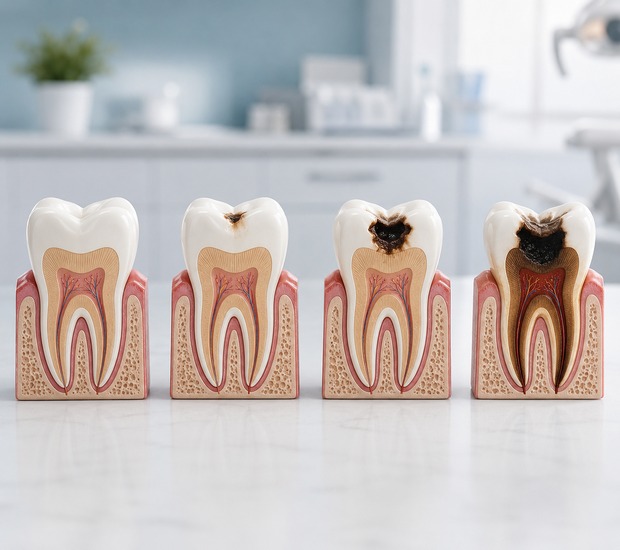
Tooth decay can progress in stages. It may begin as early enamel weakening, then move into a small cavity, deeper dentin decay, nerve irritation, infection, or a tooth that can no longer be predictably restored.
At Bailey Family Dental in Whittier, we evaluate tooth decay with an exam, X-rays when needed, symptom review, and a tooth-by-tooth look at the remaining structure. Understanding the stage of decay helps explain why one tooth may only need prevention while another may need a filling, crown, root canal, or extraction.
Clinical insight: The stage of tooth decay matters because the right treatment changes as decay moves deeper. Early enamel changes may sometimes be managed differently than a cavitated tooth or a tooth with nerve involvement.
If you are worried about a cavity or tooth decay, call Bailey Family Dental at (562) 698-8739 to schedule an evaluation.
What Are the Stages of Tooth Decay?
The stages of tooth decay describe how decay can move from the outside of the tooth toward the deeper layers. Tooth decay often starts in the enamel, the hard outer layer of the tooth. If the process continues, it can reach dentin, get close to the nerve, cause infection, or weaken the tooth badly enough that simple repair is no longer predictable.
Not every dark spot on a tooth is decay, and not every cavity hurts. Some early problems are found during a dental exam or on X-rays before the patient notices symptoms.
This page explains how decay can progress. For the broader overview of diagnosis and treatment options, visit our Cavity Treatment page.
“The earlier tooth decay is found, the more tooth structure may be preserved.”
Stage 1: Early Enamel Demineralization
The earliest stage of tooth decay may involve mineral loss in the enamel before a true hole forms. This can sometimes look like a chalky white area, a dull spot, or an area that is easier for plaque to collect. It may not hurt.
At this stage, prevention may be the main focus. Depending on the tooth and the patient’s cavity risk, we may discuss brushing and flossing habits, fluoride guidance, diet frequency, dry mouth, and regular dental cleanings.
Early enamel changes may be influenced by:
- Plaque buildup: Plaque bacteria can produce acids that weaken enamel.
- Frequent snacking or sipping: Repeated acid exposure can increase cavity risk.
- Dry mouth: Less saliva can make it harder for the mouth to neutralize acids.
- Difficult-to-clean areas: Grooves, crowded teeth, and old dental work can trap plaque.
- Inconsistent preventive care: Regular cleanings and exams can help catch problems earlier.
For prevention guidance, visit our Preventative Dental Care page. For daily brushing and flossing basics, visit our Oral Hygiene Basics page. If you are wondering whether early decay can improve, read our blog on Can a Cavity Go Away on Its Own?
Stage 2: Enamel Cavity
As enamel damage progresses, the surface may begin to break down into a true cavity. A tooth may still feel normal at this stage, or there may be mild sensitivity, roughness, food trapping, or a visible dark area.
Once the tooth surface has broken down, prevention alone may not be enough. A small to moderate cavity may need a filling if enough healthy tooth structure remains.
Clinical insight: The word “cavity” can mean different things clinically. A tiny enamel change, a visible hole, and a deep cavity near the nerve are not the same problem and may not need the same treatment.
For small to moderate cavities that can be restored with tooth-colored material, visit our Composite Fillings page. If you are unsure whether a cavity always needs treatment, read our blog on Does a Cavity Always Need a Filling?
Stage 3: Dentin Decay
Dentin is the layer under enamel. Once decay reaches dentin, it can often spread faster because dentin is softer than enamel. Symptoms may become more noticeable at this stage.
Patients may notice sensitivity to sweets, cold sensitivity, food getting stuck, discomfort when chewing, or a tooth that feels different than before. However, some dentin cavities still cause little or no pain.
Dentin decay may be associated with:
- Sensitivity to sweets: Sweet sensitivity can happen when decay exposes or irritates deeper tooth structure.
- Cold sensitivity: Cold sensitivity may happen with cavities, gum recession, cracks, or exposed dentin.
- Food trapping: Food may catch if tooth structure has broken down or if decay is between teeth.
- Chewing discomfort: Pain when chewing can suggest deeper decay, cracks, bite issues, or nerve irritation.
If sweets trigger pain, read our related blog on Why Do My Teeth Hurt When I Eat Sweets? If cold sensitivity is the main issue, visit our Tooth Sensitivity to Cold page. If food trapping or floss catching is the main issue, visit our Cavities Between Teeth page.
“A tooth can have deep decay before pain becomes constant.”
Stage 4: Deep Decay Near the Nerve
As decay moves deeper, it can get close to the nerve inside the tooth. At this stage, a simple filling may not always be predictable. The tooth may become more sensitive, painful, or uncomfortable when biting.
Treatment depends on the exam, X-rays, symptoms, and how much healthy tooth remains. Some teeth may still be restorable with a filling, inlay, onlay, or crown. Other teeth may need root canal treatment if the nerve is inflamed or infected.
Clinical insight: Deep decay does not automatically mean root canal treatment, but it does mean the tooth needs a careful evaluation. We look at symptoms, X-ray depth, remaining tooth structure, and whether the tooth can be restored predictably.
If the cavity is large, visit our Large Cavity: Filling vs. Crown vs. Root Canal page. If the tooth needs more coverage, visit our Dental Crowns page. If nerve involvement is a concern, visit our Do I Need a Root Canal? page.
Stage 5: Tooth Infection or Abscess
If decay reaches the nerve and bacteria enter the inner part of the tooth, the tooth may become infected. This can cause lingering pain, swelling, pressure, a pimple on the gums, bad taste, pain when biting, or pain that wakes a patient up at night.
A tooth infection should be evaluated promptly. Depending on the tooth, treatment may involve root canal treatment, a crown, extraction, or another option. Antibiotics alone usually do not fix the source of an infected tooth if the nerve space remains contaminated.
Possible signs of a more serious tooth problem include:
- Lingering or spontaneous pain: Pain that lasts or starts without a trigger can suggest deeper nerve irritation.
- Swelling: Gum or facial swelling should be evaluated quickly.
- Pain when biting: Biting pain can be related to infection, cracks, deep decay, or bite trauma.
- A gum pimple or drainage: This may be related to an abscess or chronic infection.
- A tooth that feels raised or different: Pressure around the root can make the bite feel off.
If tooth pain is your main concern, visit our Tooth Pain page. To understand the risks of waiting too long, read our blog on What Happens If You Do Not Fill a Cavity? If the tooth cannot be predictably restored, Tooth Extraction may be discussed.
“Pain is not the only sign that tooth decay has become serious.”
How a Dentist Determines the Stage of Tooth Decay
The stage of decay is not based on appearance alone. A dark spot may be staining, a small cavity, decay under an old filling, or something else. A tooth can also have decay between teeth that is not easy to see from the outside.
A cavity evaluation may include a visual exam, dental X-rays, checking between teeth, evaluating old fillings or crowns, reviewing symptoms, and testing the bite. The goal is to understand how deep the decay is and whether the tooth can be restored predictably.
Clinical insight: X-rays are especially helpful for cavities between teeth and for estimating how close decay is to the nerve. The final recommendation still depends on the full clinical picture, not the X-ray alone.
For more detail about why X-rays matter, read our blog on Why You Need Dental X-Rays for a Checkup. For routine exams and cleanings, visit our Dental Cleaning and Examinations page.
Why Early Tooth Decay Treatment Matters
Tooth decay usually becomes more difficult to treat as it moves deeper. A small cavity may only need a filling, while a larger cavity may need an inlay, onlay, crown, root canal treatment, or extraction. Earlier evaluation can help preserve more tooth structure when treatment is needed.
That does not mean every early spot needs drilling. Some early enamel changes may be monitored with prevention if the tooth surface is still intact and the risk factors can be addressed.
Personal insight: When patients come in early, we often have more options. Waiting until pain is severe can limit the choices and make treatment more involved. If you are wondering how long you can wait, read our blog on How Long Can You Wait to Fill a Cavity?
Why Choose Bailey Family Dental for Tooth Decay Evaluation in Whittier?
Bailey Family Dental is located in Whittier and helps patients understand cavities, tooth sensitivity, deep decay, old fillings, decay around crowns, and tooth pain. We focus on explaining what we see clearly so patients understand the stage of the problem and why a treatment option may be recommended.
During a decay evaluation, we may review symptoms, examine the tooth, take digital X-rays when needed, check the bite, and evaluate old dental work. We also look at cavity risk factors such as dry mouth, diet frequency, plaque buildup, gum recession, and difficult-to-clean areas.
Clinical insight: Whittier patients have many dental offices to choose from. Our approach is to be clear, practical, and conservative when possible, while still treating decay before it becomes more painful or more difficult to restore.
See our Google reviews: Read what patients are saying about Bailey Family Dental
Questions Answered on This Page
Q. What are the stages of tooth decay?
Q. What is early enamel demineralization?
Q. What happens when decay reaches dentin?
Q. What happens when decay gets close to the nerve?
Q. What are signs of a tooth infection?
Q. How does a dentist find the stage of decay?
People Also Ask
Q. When does a cavity need a filling?
Frequently Asked Questions
Q. Can early tooth decay be reversed?
A. Very early enamel mineral loss may sometimes be managed with prevention if the tooth surface has not broken down. Once a true hole or cavitated area forms, the tooth usually needs a restoration.
Q. Does tooth decay always hurt?
A. No. Tooth decay can be present without pain, especially in earlier stages or when decay is between teeth. Pain is more likely as decay gets deeper or irritates the nerve.
Q. How fast does tooth decay progress?
A. The speed of tooth decay varies. It can depend on plaque, diet frequency, dry mouth, tooth location, oral hygiene, enamel strength, existing dental work, and regular dental visits.
Q. How do I know what stage my cavity is in?
A. A dentist can estimate the stage of decay using an exam, X-rays, symptoms, and evaluation of the tooth structure. Appearance alone is not enough to determine the stage accurately.
Q. When does tooth decay need a root canal?
A. Root canal treatment may be needed if decay reaches the nerve, causes infection, or creates symptoms that suggest the nerve is irreversibly inflamed or infected. The decision depends on the exam and X-ray findings.
Q. Can a tooth be too decayed to save?
A. Yes. If decay destroys too much tooth structure or the tooth cannot be restored predictably, extraction may be discussed. The goal is to determine whether the tooth can function safely long term.
Reviewed by Brian Choi, DMD
General Dentist at Bailey Family Dental in Whittier, CA
Reviewed: August 2026
Schedule a Tooth Decay Evaluation in Whittier
Tooth decay is easier to manage when it is found earlier. Bailey Family Dental can evaluate the tooth, explain the stage of the problem, and recommend the right next step based on the exam and X-ray findings.
Call Bailey Family Dental in Whittier at 562-698-8739 to schedule a tooth decay evaluation.